
Workday Implementation Cost: Key Factors That Affect Pricing
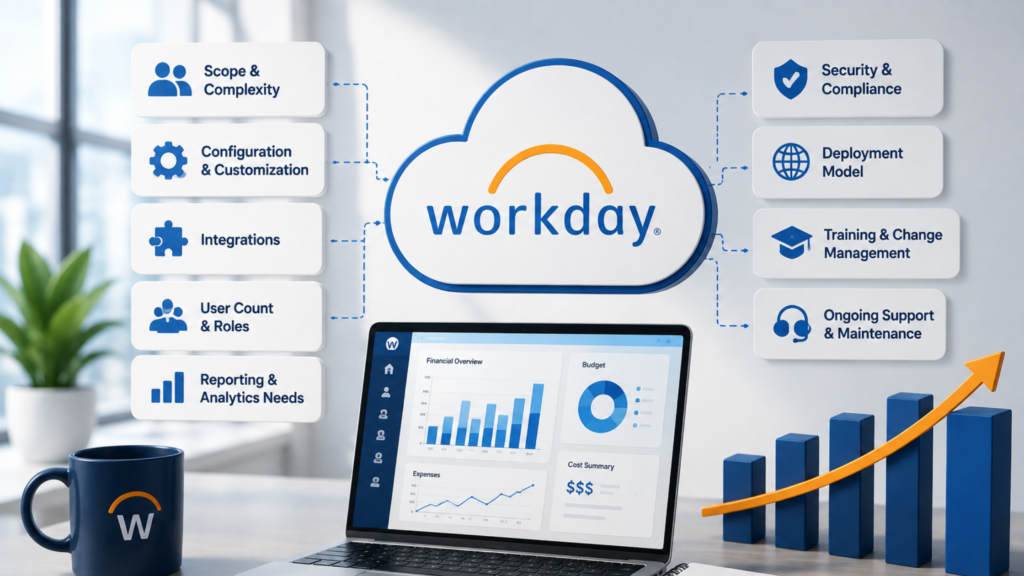
Implementing Workday can be a significant investment for organizations looking to modernize their human resources, finance, payroll, and enterprise management processes. However, there is no single price that applies to every Workday implementation.
The Workday Implementation Cost can vary substantially depending on the size of the organization, modules being deployed, data migration requirements, integrations, configuration, geographic scope, change management, and implementation partner.
Understanding these factors before starting a Workday project can help organizations create a more realistic budget and reduce the risk of unexpected expenses.
Explore our services: https://clientbridge.ai/services/
What Is Included in a Workday Implementation?
ClientBridge provides Workday pre-deployment assistance and deployment support covering the transition from initial setup through launch. It also provides Phase X and post-production maintenance services.
Key Factors That Affect Workday Implementation Cost
1. Number of Workday Modules
One of the biggest factors affecting Workday Implementation Pricing is the number of modules being implemented.
An organization implementing only core HCM will generally have a different project scope from one implementing multiple areas such as:
- Human Capital Management
- Payroll
- Recruiting
- Benefits
- Time Tracking
- Financial Management
- Procurement
- Learning
- Adaptive Planning
2. Organization Size
The size and complexity of an organization can have a significant impact on implementation requirements.
A company with several hundred employees may have fewer business processes, locations, integrations, and data requirements than a multinational organization with thousands of employees across multiple countries.
3. Data Migration
Data migration is one of the most important areas to budget for.
Organizations moving from legacy HR or ERP systems may have years of employee, payroll, organizational, financial, and other business data.
Before that information can be moved into Workday, it may need to be:
- Extracted from legacy systems
- Reviewed for accuracy
- Cleaned
- Standardized
- Mapped to Workday structures
- Loaded into the new environment
- Validated through testing
Poor-quality legacy data can increase the time and effort required for migration.
Industry cost analyses consistently identify data migration as a major implementation cost driver.
4. Number and Complexity of Integrations
Most organizations do not use Workday in isolation.
Workday may need to exchange information with:
- Payroll providers
- Benefits platforms
- Banks
- Timekeeping systems
- Identity-management systems
- Financial systems
- Recruiting platforms
- Learning platforms
- Other enterprise applications
Every integration can require requirements analysis, development or configuration, testing, security review, and ongoing maintenance.
The more integrations a company requires, the greater the potential implementation cost.
5. Business Process Complexity
Organizations often have unique HR and finance processes developed over many years.
During implementation, teams need to determine which existing processes should be:
- Adopted as they are
- Simplified
- Standardized
- Reconfigured
- Replaced with Workday functionality
Complex approval workflows, organizational structures, compensation rules, payroll requirements, and financial processes can increase configuration and testing requirements.
A clear business-process assessment before implementation can help organizations identify complexity early.
6. Geographic and Regulatory Requirements
A global Workday deployment can be substantially more complex than a single-country implementation.
Different countries can have different requirements related to:
- Payroll
- Employment regulations
- Taxation
- Benefits
- Reporting
- Data protection
- Currency
- Local business processes
Adding countries can therefore increase configuration, testing, localization, training, and change-management requirements.
Organizations planning global deployments should identify country-specific requirements during the planning phase rather than treating them as late-stage additions.
Workday Implementation Cost: One-Time vs. Ongoing Expenses
When creating a Workday budget, organizations should separate implementation expenses from ongoing costs.
Why Workday Implementation Support Matters
A successful Workday deployment requires more than technical configuration.
Organizations need a structured approach to planning, process design, data migration, integration, testing, training, deployment, and post-production support.
ClientBridge offers Workday pre-deployment assistance, deployment support, Phase X and post-production maintenance, staff augmentation, and advisory and optimization services.
This range of services allows organizations to seek support at different stages of their Workday journey rather than treating implementation as a single isolated event.
Conclusion
The Workday Implementation Cost varies from organization to organization. There is no universal price because every implementation has different requirements.
The best way to create an accurate budget is to define the implementation scope, assess existing systems and data, identify integration requirements, and obtain a detailed proposal based on the organization’s specific needs.
Follow us on instagram: https://www.instagram.com/client.bridge/
FAQs
1. What is the average Workday implementation cost?
There is no universal average. Current 2026 industry benchmarks show costs ranging from hundreds of thousands of dollars for smaller implementations to several million dollars for large, complex deployments.
2. What is the biggest factor affecting Workday implementation cost?
The biggest factors generally include module scope, organization size, data migration, integrations, business-process complexity, and implementation partner effort.
3. Does data migration increase Workday implementation pricing?
Yes. Legacy data often needs to be extracted, cleaned, transformed, mapped, loaded, and validated. Complex or poor-quality data can significantly increase project effort.
4. Do Workday integrations increase implementation costs?
Yes. Each integration may require analysis, configuration or development, testing, security review, and ongoing maintenance.
5. Can Workday implementation costs be reduced?
Organizations can improve cost control by defining scope clearly, prioritizing critical requirements, preparing data early, using standard functionality where appropriate, and carefully selecting an implementation partner.